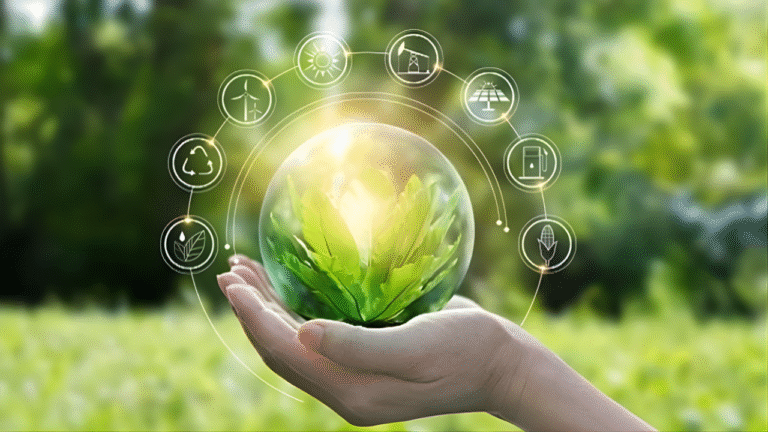
Exploring whether the global sustainability movement marks a genuine transformation or just another short-lived economic trend dressed in green.
The Dawn of the Green Gold Rush
They call it the Green Gold Rush — a race where innovation wears the color of conscience and every brand wants to prove it’s saving the planet. From billion-dollar climate startups to eco-friendly fashion and carbon-neutral coffee cups, “green” has become both a badge of ethics and a business model.
In just over a decade, sustainability has grown from a buzzword into a movement shaping markets, policies, and consumer choices. Global ESG (Environmental, Social, and Governance) investments surpassed $35 trillion in 2022, nearly one-third of all managed assets. The World Economic Forum predicts that the green economy could create $10 trillion annually and 395 million jobs by 2030. From solar farms blanketing deserts to electric cars dominating highways, the shift to green has turned into both a moral duty and an economic opportunity. Yet beneath the optimism lies a question: can the world sustain this boom?
The Case for Real Progress
There’s plenty to be hopeful about. In the past decade, solar costs have fallen by 80% and onshore wind costs by 55%. The International Energy Agency expects renewables to surpass coal capacity by 2027 — a major milestone for clean energy.
Corporate accountability has also deepened. Over 90% of S&P 500 companies now publish sustainability reports, and tech giants like Apple and Microsoft plan to reach net-zero within 20 years. Governments are moving too — from the EU’s €1-trillion Green Deal to India’s National Green Hydrogen Mission, they’re turning promises into policy.
Economically, the green transition is already paying off. The International Labour Organization projects millions of new jobs in renewable and environmental sectors over the next decade. For many countries, this isn’t just about saving the planet; it’s a new form of industrial growth — proof that ethics and economics can finally align.
Hype, Greenwashing, and the Dark Twin
But not everything that glitters is green. The rise of sustainability has brought its shadow: greenwashing, where companies market “eco-friendly” products without real impact. A 2023 European Commission study found that 42% of corporate green claims were exaggerated or unverifiable.
Major brands have stumbled. H&M’s “Conscious Collection,” Shell’s “carbon-neutral” ads, and Nestlé’s vague pledges show how sustainability can be stretched thin. Even ESG investing isn’t immune — some “green” funds still include fossil fuels. Critics warn ESG could turn into a moral marketing tool rather than a genuine climate solution. Unchecked hype also risks inflating a green bubble. If real-world results fail to match the rhetoric, investor confidence could collapse, echoing past speculative crashes.
The Economics of Sustainability
Financially, sustainability is one of the fastest-growing markets worldwide. Green bond issuance exceeded $500 billion in 2023, channeling huge capital toward climate-friendly projects. Governments are fueling the shift — the U.S. Inflation Reduction Act (2022) alone committed $370 billion to clean-energy incentives, one of the largest climate investments ever.
Still, economists warn that rapid capital inflows can inflate valuations faster than measurable progress. The pattern resembles the late-1990s dot-com boom — breakthrough innovation mixed with speculative hype. Yet, like the internet, early corrections may strengthen the revolution rather than stop it.
Beyond the Buzz: Proof Matters
The next challenge is proving results. Promises aren’t enough; companies must now show measurable impact through carbon accounting, lifecycle analysis, and transparent reporting. ESG standards are evolving to prioritize evidence over advertising.
Some pioneers set the bar high. Denmark recycles over 70% of its waste through circular systems. Tesla publishes lifecycle carbon data for every vehicle. Patagonia donates profits to conservation causes, turning sustainability into identity, not image.
But for every genuine effort, hollow slogans persist. Claims like “carbon-neutral by 2030” mean little without third-party verification. The future of sustainability must focus on depth over declarations — real outcomes, not just optics.
The Future: Revolution or Regression?
Innovation is racing ahead — from carbon capture and bio-based plastics to AI-driven climate modeling. Consumers, especially Gen Z, demand authenticity and reward brands that live up to their values.
Yet without transparent reporting and global policy alignment, sustainability risks becoming another empty buzzword. The 1.5°C climate target is slipping away, and “green” may lose meaning if not grounded in verifiable progress. Still, there’s reason for optimism. Sustainability is imperfect, but too deeply rooted in global economics and culture to fade. The world is changing — not just in markets, but in mindset.
Conclusion: From Hype to Habit
Every gold rush begins with excitement. Real value lies in what lasts beyond the shine. Sustainability isn’t just about saving the planet; it’s about making progress that endures.
If innovation continues to meet integrity, this rush won’t burst — it will bloom. Because true progress, like the environment it protects, is measured not by speed, but by survival.
Sources:
International Energy Agency (IEA): Renewables 2023 Global Report
World Economic Forum: Future of Jobs Report 2023
European Commission: Screening of Environmental Claims 2023
International Labour Organization: World Employment and Social Outlook 2022
U.S. Inflation Reduction Act 2022 Summary (White House Brief)
MSCI & Sustainalytics ESG Frameworks
Forbes, Bloomberg Green, The Economist Climate Briefings